
Demystifying AI Interview Intelligence: A Guide for Talent Acquisition Leaders

The demand for artificial intelligence expertise in talent acquisition is no longer a futuristic concept. It is a present reality.
When organizations evaluate recruitment partnerships, the ability to bring proven strategies for AI usage consistently ranks as a top priority. However, the conversation around AI often lacks specificity. Rather than focusing on theoretical applications, talent acquisition leaders must look at practical solutions that drive measurable business outcomes. One of the most impactful subsets of this technology is interview intelligence.
What Is Interview Intelligence?
Interview intelligence tools are purpose-built, standalone platforms designed to capture, transcribe, summarize, and analyze hiring conversations. This applies to both live and recorded interactions between recruiters and candidates. It is important to distinguish these tools from full Applicant Tracking Systems or comprehensive human resources suites. They are point solutions intended to sit alongside an existing ATS and video platform. Their primary function is to augment human interviewers rather than replace them with fully automated AI agents.
The core promise of these tools is simple. They stop making recruiters split their attention between listening to the candidate and typing notes. When interviewers can stay fully present, the quality of the conversation improves, the candidate experience improves, and the documentation pushed to the ATS is more accurate and consistent. In high-volume environments, these tools create standardized output across large, distributed interviewing teams.
Navigating the Regulatory and Compliance Landscape
Adopting AI in the hiring process requires a rigorous approach to compliance. Tools that cross the line from documentation into automated decision-making trigger significant regulatory scrutiny. Talent acquisition leaders must evaluate these platforms through a practical risk lens that accounts for several emerging frameworks:
- Automated Decision and Scoring Rules: Jurisdictions are increasingly regulating algorithmic evaluation. A primary example is the New York City Automated Employment Decision Tools (AEDT) law, which mandates bias audits and candidate notice obligations when AI significantly influences selection procedures.
- Video Evaluation Transparency: Regulations like the Illinois Artificial Intelligence Video Interview Act strictly govern how AI video evaluation is used, requiring specific consent, transparency, and data deletion protocols.
- Federal Anti-Discrimination Scrutiny: The Equal Employment Opportunity Commission (EEOC) has issued guidance emphasizing that existing anti-discrimination frameworks apply directly to algorithmic tools used in selection procedures.
- Global Frameworks: For international organizations, the EU AI Act classifies employment and recruiting AI as high-risk systems. These systems will face strict, staged obligations leading up to broad applicability in August 2026
Understanding these frameworks is critical. Purpose-built tools that strictly handle transcription and notes carry far less risk than tools utilizing AI to score or rank candidates.
The Four Clusters of the Ecosystem
Not every tool in this space attempts to solve the same problem. The ecosystem breaks down into four distinct categories based on primary focus and buyer fit.
- Recruiter-First Interview Intelligence Platforms: These tools were built from the ground up for recruiters and hiring managers. They feature robust compliance frameworks and workflow features that mirror how recruiters actually work. This cluster represents interview intelligence in the truest sense.
- Recruiter-Specific AI Notetakers: These are lighter-weight tools tuned for recruiting workflows. They generate candidate profiles and sync to the ATS without the deeper analytics or coaching layers found in the first cluster. They are often faster to deploy and get through IT security.
- Structured Interview and Coaching Platforms: Going beyond simple capture, these tools focus on how interviewers conduct interviews. They build structured question guides, train interviewers, and provide feedback loops. They are best suited for organizations where the quality of the interview itself is the primary problem to solve.
- Video Interview Platforms with an Intelligence Layer: These solutions began as video interview platforms and subsequently added AI intelligence features. While widely known, they are typically not as deep on the intelligence side as native recruiter-first tools.
Deep Dive: Top Players Comparison Matrix
Understanding the specific strengths and limitations of each platform is critical for aligning the right tool with your organizational objectives. The following matrix outlines the top vendors within the dedicated interview intelligence space.
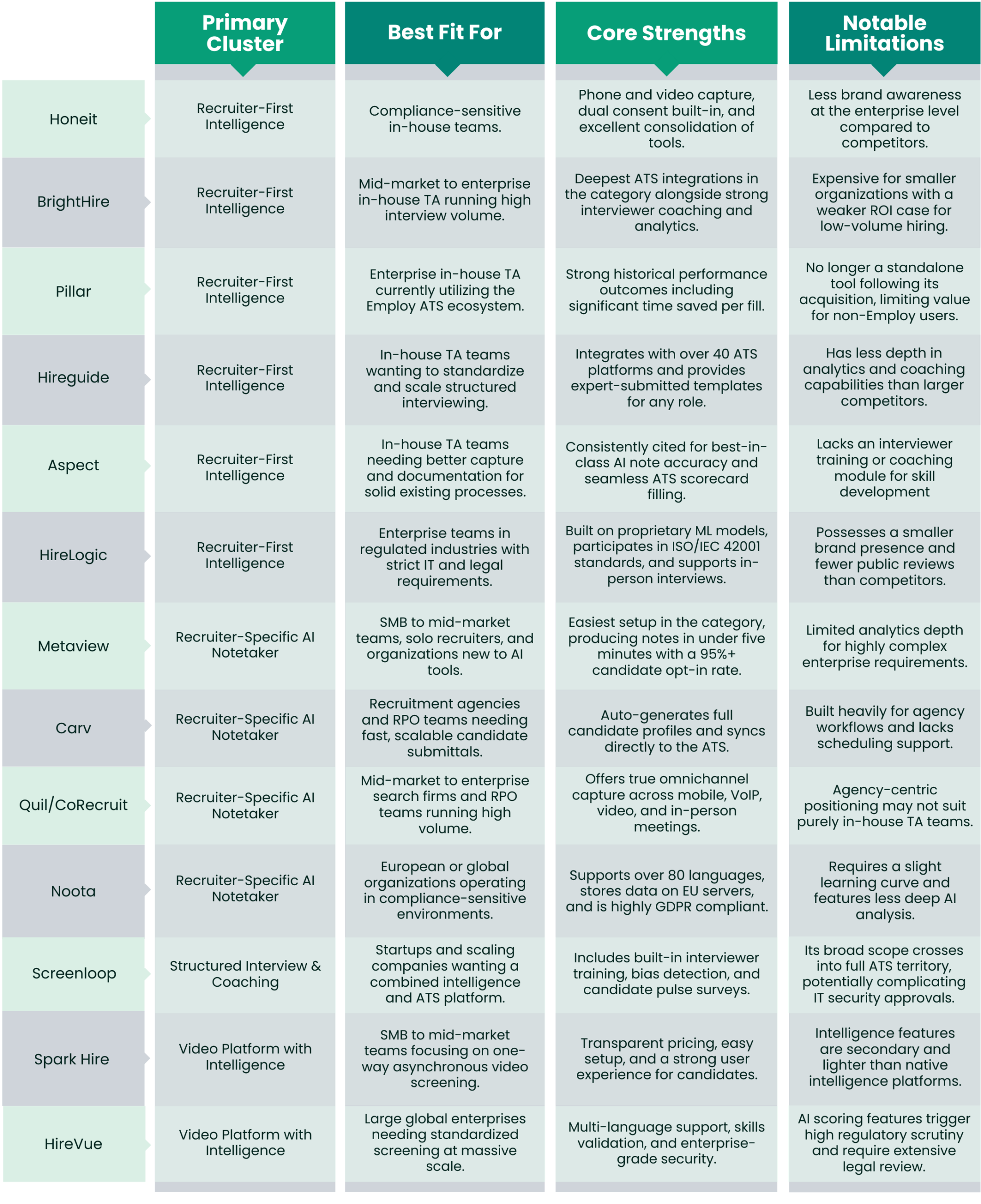
Category-Wide Realities: What Works and What Does Not
The benefits of adopting interview intelligence are highly quantifiable. Users across platforms consistently report saving three to eight hours per week per recruiter through automated notes and summaries. Consistency improves dramatically as structured templates reduce variability between interviewers. Documentation quality increases because AI-generated notes pushed to the ATS are more complete than handwritten notes. This level of detail also builds a much stronger foundation of trust between recruiters and hiring managers. The technology raises the bar on how candidates are presented by providing elevated write-ups alongside the option for managers to listen directly to a candidate’s response to key questions. This transparency eliminates second-guessing, which can reduce the number of interview cycles and speed up the hiring process over time. Additionally, tools with feedback loops create interviewer coaching potential, and structured data creates an audit trail that supports bias reduction.
However, the category has distinct challenges. Candidate consent and recording laws are a minefield. Organizations must implement clear consent workflows, and they must think about where their candidates are located rather than just where the company is headquartered. Over-reliance is another operational risk. AI summaries can miss nuance or misattribute statements, meaning human review remains necessary. Finally, data retention policies for interview recordings are often undefined, creating long-term legal exposure if not actively managed alongside IT.
The Strategic Path Forward
The true value of interview intelligence does not come from simply purchasing a software license. The failure mode in this category is rarely buying the wrong tool. It is buying the right tool and seeing inconsistent user adoption across the hiring team. Success requires designing the process around the technology, managing the implementation, and ensuring the human judgment layer remains intact.
AI should enhance your interviewers, not replace their judgment. There is a fundamental difference between tools that help humans make better decisions and tools that make decisions on their behalf. Drawing that line clearly, establishing proper change management, and rigorously managing compliance will ultimately determine whether an organization realizes the full strategic value of its hiring technology stack. Before committing to long-term enterprise contracts, organizations should design structured pilots based on clear success metrics to validate their approach and ensure complete legal alignment.