
Five Fatal Errors Companies Make When Outsourcing Hiring
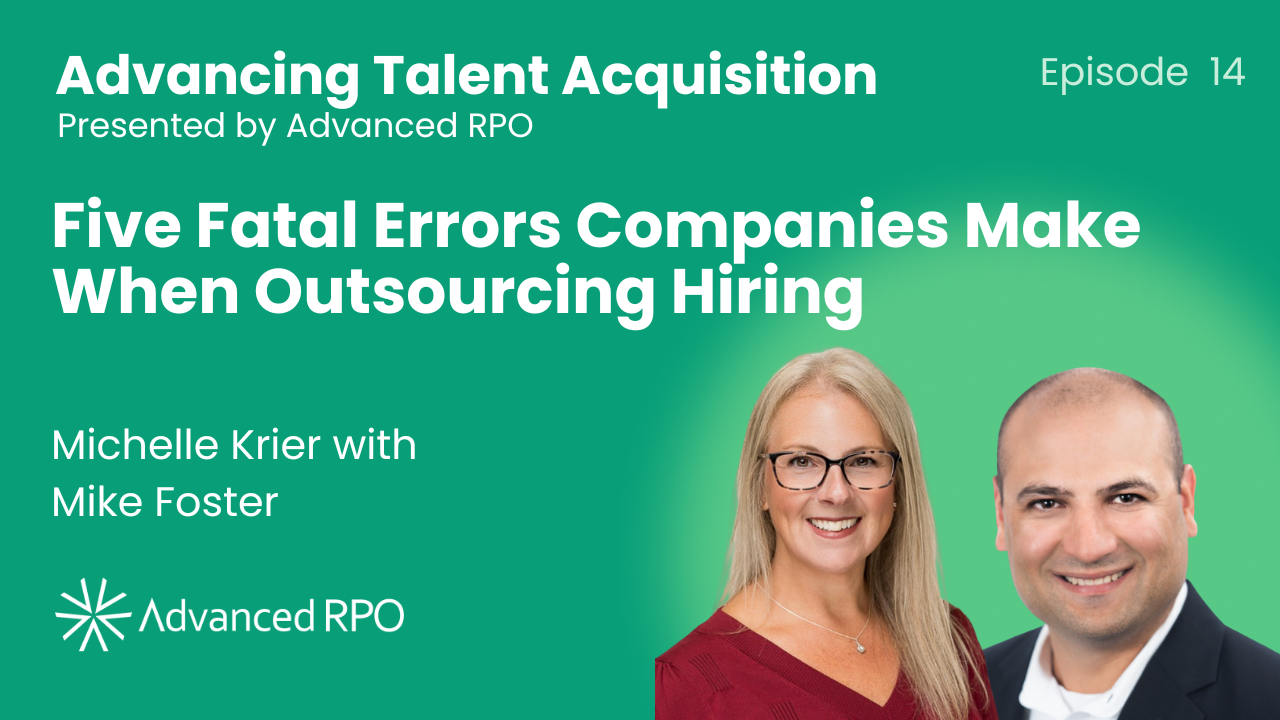
Outsourcing recruitment can transform hiring outcomes—but only if it’s done right. Learn how to avoid five critical missteps and strengthen your RPO partnerships.


Summary
In this episode of Advancing Talent Acquisition, Michelle Krier sits down with Mike Foster, Client Services Director at Advanced RPO, to unpack the five most common mistakes companies make when outsourcing recruitment. Drawing on more than 15 years of talent acquisition and RPO leadership experience, Mike shares real-world lessons on how unclear goals, “set it and forget it” mindsets, poor communication, process misalignment, and ignoring data can derail success. Together, Michelle and Mike explore how organizations can avoid these pitfalls, embrace change management, and build RPO partnerships that deliver lasting impact.
Episode 14
Michelle Krier
Welcome to the Advanced RPO Podcast, Advancing Talent Acquisition. Our guest today is Mike Foster, Client Services Director and my colleague here at Advanced RPO. Welcome Mike and thanks for joining me today.
Mike Foster
Thanks, Michelle. And I appreciate the invite. I’ve been watching many of these and just waiting patiently for hopefully my turn one day. And I’m excited that I finally got one here.
Michelle Krier
Excellent. So today we’re diving into a topic that a lot of talent acquisition leaders wrestle with, outsourcing we do though, I want to give you the opportunity to share with the audience a little bit more about your background and experiences in the field of TA and recruiting.
Mike Foster
Yeah, and my pleasure. So again to everybody, my name is Mike Foster. I’m director at Advanced RPO. I’ve been with Advanced for seven years now. It feels like it’s just been a couple, but certainly tenure is getting there and it’s been a fantastic ride. But I’ve been in recruiting now for a little over 15 years. I started as an IT recruiter working for a boutique staffing firm out of Philadelphia. Since then, I have moved to Charleston, South Carolina, where I currently And I’ve worked within RPO for 11 of those 15 years. And I’ve managed recruitment teams for about 11 of those years where I’ve managed little boutique type of staffing arrangements, but bigger programs as well. So having 4,000 hires – things like that been there, but also been down to where it’s 50 to 100 hires a year. So each of them come with their own customizations and fun and catering. I’d like to always say I’ve seen it all and then COVID hit and the economy and things now and every day is a new experience.
Michelle Krier
Well, you clearly have a lot of really good experience that you’ll cite during this conversation today, I’m sure. and that’s what I want to hear about from you. So perspective about the five what we’re calling fatal flaws that companies make when they’re outsourcing hiring. We know when it happens correctly, that the results can really be transformative. But we also see the other side of the coin, unfortunately, periodically as well. And it feels to me like there are some common themes that run through those engagements when they don’t go as well as we would hope they would. that’s what we’re gonna talk about today, those five fatal flaws. the first one I’d love to hear some of your perspective around, Mike, is really lack of clear goals and success metrics. what happens when a company just jumps right into an RPO relationship and either doesn’t want to talk about or just glosses over what their definition of success is?
Mike Foster
Yeah And what you’ll tend to probably hear a theme throughout with most of my answers, the start of the partnership, the implementation, even, in that sales process, a lot of this stuff’s being discussed and formulated and things that upfront part of the partnership is what dictates the whole rest of, of that organization. like, as much as you start to feel out vendors and things like that, you can start to see the partnership and how they’re going to interact with you from the start, know, in the sales, through implementation and things like that as well. With that, setting clear goals and getting an understanding of what success actually looks like is honestly one of most important things that I try and establish right at the beginning. That doesn’t mean that it won’t change in the future, it won’t shift, it won’t adjust.
I think it’s important that you’re constantly looking at what success means and how it is. Hopefully as you start to prove success, there’s new success measures down the line, that you’re not just settling for status quo. But if you don’t know what success looks like measure that then it ultimately just comes down to everyone’s gut opinion and unfortunately my gut opinion to Michelle your gut opinion to our clients all can be very different and you want to rule out as much of that distraction as you possibly can so you know we tend to spend a lot of time one starting to learn your current process you how you’re doing it today to understand what does success look like today? Then start to look at, in the future, what does success look like in the future? Then go, okay, what goals or metrics can we set to get there? Some of those could be your standard time to fiddle, time to offer, interview to hire, candidate surveys, different things like that to see how things are going, sub-cycle times.
There’s all sorts of different metrics that you can kind of plug and play. I do highly recommend looking at what is important to you as an organization from those metrics, but also don’t key on just one metric as this is a pass or fail. What does that whole story look like? Okay, if the time to fill number that you’re looking maybe three, four months down the road, you’re not hitting that number, well, maybe that number is not achievable and it wasn’t set correctly. Or the sub-cycle times within that, what is actually holding up the process? Are there bottlenecks in the process? Are your candidates having a great experience when they come through? You can get that by surveys, the hiring manager surveys. Are the hiring managers happy? So looking at that total story helps build a business case with data behind it to support, is this a successful venture?
Michelle Krier
And I would say too that when you’re first starting out in this relationship as the client, your first success metric, maybe for the first six months or 12 months, could be very different than what it looks like three years down the road. Maybe you just need to define and follow processes. Maybe that’s the first thing that you’re looking at from a success standpoint. And then you can start looking at those incremental changes to some of those other metrics that you’re looking at and tracking.
Mike Foster
Yeah, no, I mean first success metrics usually around implementation. You how long is implementation going to take? You know, when we come out of implementation, all the pieces that need to be implemented and up and running, you what does that timeline look like? What’s that goal? How do we measure that to be successful? I would say you’re probably looking at these, you know, every few months to really get a sense around, you know, are these the right measures? Are they not? You sometimes time to fill is a great measure for some companies. Some companies are more worried about, lLke hey it might take a little bit longer but I want to make sure that you’re sending quality people into the interview. The interview to hire is one of the more important metrics and things like that. I tend to go as much data as you can pull into your system support you know that you can pull in as much as you want but then look at it overall to see what is that story really telling us.
Michelle Krier
Yeah, absolutely. So let’s move on to error number two. Treating the engagement like a set it and forget it. Okay, I’ve hired somebody who’s gonna take care of this, I get to wash my hands and walk away. So why is it risky for companies to completely take a hands off approach once they engage an external partner?
Mike Foster
Yeah. For one, I think you want to know how we’re performing, how we’re integrating with your business, how we’re treating your candidates. As an RPO provider, we’re going out to the market, we’re acting to your hiring manager as an extension of your company. So we represent your brand, we represent what you want to be out there in the market. So it’s important for you to stay current with how are we doing, how is that working, you know, set it and forget it sounds like almost like a, you know, as a manager of a TA team, if people were like, “Hey, just handle it and I don’t have to worry about it”.
Sometimes it sounds like a bit of a dream, I’ll be honest. Usually my best clients are the ones that are engaged with me. You know, if there’s challenges, if there’s, difficulty in the hiring process, sometimes it takes, a few people, your point of contact and things like that to help you, remove those roadblocks and things like that, to ultimately make the recruiters more successful in the account. I would say I’ve been doing this for a long time. I’ve never been in an operation to where it’s like, okay, set it, forget it, see you later, and things just run smoothly. This is the people business. That means things happen quite often. And the set it forget it mentality is really just setting you up to probably deal with things that you’re not ready for. Usually at that point, similar to the clear goals conversation, if you’re not really paying attention, when you find out there’s problems, it’s usually coming from executives, hiring managers, candidates. You don’t want to let it get to that point. You want to make sure you’re on the forefront. You’re finding out where the problems and roadblocks are well before it ever gets into your candidate hiring manager.
Michelle Krier
Absolutely. Error number three, poor change management and internal communication. So we know that entering into a partnership like this with our clients requires not only change management, but a lot of communication, right? You’re letting multiple stakeholders in the organization know about this partnership, as well as changes to process, potentially new technologies, right? Introducing new contacts, all sorts of things. So what steps can companies take to make that transition a little bit more smooth?
Mike Foster
It is honestly one of the harder things. It’s something that I’m not going to sit here and say is easy and anybody has a perfect answer to it. It is something that we actively do work with our clients in crafting that type of plan during an implementation. Something we also discuss during the sales process and things like that. Understanding what other people around the organization know. Do they understand what an RPO is and things like that. Typically, a lot of what we see as hiring managers have with a staffing agency before and don’t really understand the full engagement of an outsourced solution. And that’s probably some of the bigger change management where at times a hiring manager will just want to throw a job description to a recruiter and say, okay, I’ll see you when you have some candidates. And it’s really important to make sure that they understand the importance of an intake conversation, how we utilize our process and what the expectations are. Honestly, what our goals and our success metrics are.
So, when we’re thinking of success, worst thing for us is half the organization thinks one thing is success and we think another thing is success. So I would say over communicating is usually something that I would highly recommend. You’re going to have when you launch some update calls where you’re asking hiring managers and stakeholders to join calls and you’re probably going go through, here’s all the process and expectations.
To be honest with you, lot of hiring managers have a lot of things going on during the day and they’re probably multitasking things during it. So I would automatically assume just because you have one meeting and we roll it out – that you can’t check that off as a boss. That change management has to continue for a very long time. Your entire outsource provider, the recruiters, the coordinators, the manager, all have to understand it. Every conversation they’re having with people in your organization, they can be educated and helping with that change management and understanding and things like that and things that you want to continue to reevaluate. And if you’re seeing things where it seems like people aren’t understanding or there maybe something wasn’t communicated, get on it right away. The longer you wait on it, the worse it gets.
Michelle Krier
Yes, and there’s a lot of studies out there that state that the one thing employees want generally across the board, no matter what company they’re working with, even if they’re not outsourcing this particular function, it’s just better internal communication. And we know that, to your point about hiring managers having a lot on their plates, no one’s going to remember because you told them one, two, three, four, even five times, right? It’s just until it becomes something that they are responsible for interacting with, right, in an engagement such as probably not going to pay attention to it in one ear and out the other.
Mike Foster
Yeah, usually the people in the beginning during the implementation that are focused a lot are the ones that have active hiring needs in that given moment. There’s other hiring managers and stakeholders and things like that that may not actually use the service for a year or two years down the road. So those people like, yeah, you’re gonna have your upfront communication, but there’s gonna have to be some type of, you know, process to where you’re almost re-educating at the time that they need different things and how that process is. And, you got to be okay with being able to kind of re-educate and jump in and have those types of conversations. to expect the hiring manager from, you know, two years ago to remember what your process is, like, I don’t think that’s fair of them. And I don’t think it’s productive. you know, having some metrics, whether we’re to recruit or schedule an intake conversation with the new manager, maybe there’s a one-pager on, this is the process. Here’s our expectations. Those are all things that I tend to work with my team to create to help set proper expectations with everybody.
Michelle Krier
So along the same lines of change management internal comms is our next fatal flaw or error, which is process misalignment, right? So oftentimes, again, I feel like companies say, okay, great, we want you to come in and take over this recruiting and hiring function for us. And they’re forgetting about the process that needs to evolve along with the outsourcing of the actual function. So why can either an outdated or an inefficient process really doom a partnership from the start?
Mike Foster
Yeah, no, that’s a great question. Even before that, one of the challenges that I’ll mention from a process misalignment and something that I think as we partner with folks that can certainly help, I think both sides of that equation. lot of times during the sales process, we’re interacting with pretty high level business stakeholders that may not be the ones that are actually in that process every single day. So this is no fault or knock of anybody during the sales process, but like, sometimes getting down into every little detail on a recruitment process is very challenging.
As we get closer into implementation, I do highly recommend, really look at your internal team and go, okay, who knows this process in and out that we need to have involved to make sure that you have the right stakeholders from the beginning in on the conversation. What I have certainly seen is we have spent weeks of implementation time. We go live, and it turns out that we don’t have the process correct or it wasn’t, it was, well, I didn’t think of that or I forgot that. Those are the things you want to try and weed out as much as possible. Through that implementation part, one of the things that we try and do is if you have a current process that you’re using, we’ll try and look at it and are there recommendations and things that we can do to help you improve that process? We see hundreds and hundreds and hundreds of different recruitment processes. Some work unbelievably, some could use a little bit of help, isn’t that a nice way to put it? Some are right in between.
And that doesn’t mean that a recruitment process that I say works great for one customer may not work for you. like, again, being in the people business, you know, and trying to solve your hiring problems, it is very hard for us to say that there’s a one-fix solution to it what that process should absolutely look like. And I think that’s one of the things that I love about working for Advanced, its giving me the opportunity to be part of that with my clients as opposed to providing like a one-stop shop solution. What I would say is look at, process and efficiencies and things like that is trying to figure out how do you have the fastest recruitment process that doesn’t sacrifice quality and get you the hires that you need in the quantity that you need. You know, and if you always look at everything from that lens, you know, it really kind of brings a little bit of a different light. You know, we tend to see some folks and customers that are really struggling hiring. And as soon you get into the process, they have two assessments before a recruiter meets the meets the candidate. Those two assessments, you find out no one’s even looking at. So we’re not sure why they’re even using them. The recruiter talks and then there’s, you know, six rounds of interviews. And then there’s an on-site and you start going through and start looking at the process and it’s like, okay, well, can we identify just stakeholders that are decision makers. Why don’t we just have those in the process and you look at all the different steps that a candidate is going through in a process and starting to determine, you know, what is the most efficient? You know, if there’s an assessment that works for you that you need to put in there, okay, if it makes sense. But a lot of times there’s a lot of things in recruitment processes that aren’t actually part of the decision making on hiring and if it’s in there and you’re not using it as a decision-making tool, then I always recommend get rid of it and shorten your process as quickly as you can without sacrificing quality is really important because in the end, a quality hire is what we’re all trying to achieve.
Michelle Krier
That is such a great segue into the last error or fatal flaw that I want you to talk about, which is ignoring data and ignoring continuous improvement. And, I have the great benefit of seeing across all of our clients, right? A lot of the recommendations that you and other account leaders are providing to clients on a regular basis. We look at a lot of data, we analyze a lot of data, we provide a lot of recommendations. So, what have you seen where, I guess, do you see companies fall down when we give them those recommendations and that data? Is it, you know, they’re not taking an action? Is there, like, just talk me through why that’s a fatal flaw for companies.
Mike Foster
It actually fits into a few of the topics that we discussed today, but I would say what I tend to see when you’re kind of ignoring some data or ignoring an opportunity to continuously improve. A lot of that comes down to the relationships and the change management efforts that you put in in the beginning and things like that. One of the hardest things sometimes is people get very used to what the process was or how it’s been running. Change is tough for a lot of people. I’m not going to sit here and say that everything from a change perspective that I go through is easy by any means. But many times people start to ignore things in a recruitment process or in a relationship, because they’re afraid of how that’s going to affect somebody from a change perspective. also sometimes one person is challenging something in the process or here. it’s just, we’ll add this one step in. And then the next person comes, we’ll add this one step in. And sometimes you have to have a deep internal conversation with yourself. They’re like, is this the right decision for the future of the business? Or are we just trying to handle a one-off problem?
And it’s going to ultimately not reflect in the long-term relationship and things like that. So I would initially say a lot of that comes back to communication and the change management piece of it. I think anything in life, if you don’t pay attention to it, it’s usually not the best approach for anything. So I always, if you can pay attention, change management is a lot easier when you have data behind it. So once you set those measurements, those goals, and you have the data to support the change that you think, then working with us on what is that strategy that we can take to the business state leaders that need to sign off on different things and be part of it. How can we help you align yourself to ultimately help make that recommendation that we feel is going to be beneficial for everybody. So kind of goes back to communication, which I think you can probably hit on every single one of these failed flaws, which is communication, communication, communication.
Michelle Krier
Yes, it’s a common theme. That’s for sure. All right, so last question. If you could give one piece of advice to a company who’s considering an RPO partnership for the first time, they’ve never entered into an arrangement like this. One piece of advice, what would it be?
Mike Foster
So what I would say, and as an RPO industry, I hope that we start getting a little bit better at this, but RPO overall means a lot of things to a lot of different people. So when you’re going out and you’re working in an RPO, I do think it’s very important to really understand what are you trying to achieve out of that relationship and how does that relationship fit within your business. You know, us personally, we’re pretty customizable. like in a sales process, it may feel like we’re asking a lot of questions, but we’re trying to understand how do we design something that’s going to fit with as little disruption as possible in a lot of success. There’s a lot of RPOs out there that, you know, are kind of like a staffing company. We’re contract recruiters. we tend to sit in the, you know, an outsourced talent acquisition type of function where we’re going to help you develop and become more efficient and be very strategic in our partnership. There’s case studies for each of those different use cases within RPO. And I would say, as much as you can understand what your actual need is, and then as you’re talking to RPO providers, really get a sense on what type of RPO solution are they trying to actually provide to you.
Michelle Krier
Thanks, Mike for joining us today and for all the insights. For our listeners, if there’s a topic that we haven’t covered that you’re interested in hearing about, please leave a note in the comments and we’ll work on getting that into the rotation. Thank you.
About our experts

Michelle Krier
Michelle Krier has built her career at the intersection of sales, marketing, and talent acquisition, helping organizations align strategy and solve complex workforce challenges. As Senior Vice President of Marketing at Advanced RPO, she leads brand, content, and demand generation efforts that connect companies with the recruiting solutions they need to thrive. She brings a broad perspective shaped by years working with staffing firms, RPOs, MSPs, and HR technology providers, as well as directly with corporate HR and TA teams on employer branding and recruitment marketing strategies. Earlier in her career, she pioneered one of the first social recruiting and talent attraction services in the RPO industry, setting the stage for what is now a foundational element of modern RPO solutions. With this mix of experience, Michelle brings clarity, industry insight, and practical perspective to conversations about the future of recruiting.

Mike Foster
Mike Foster is a global talent acquisition leader with more than a decade of experience spanning recruiting, client strategy, and team leadership. He began his career as a technical recruiter before moving into RPO, where he managed global client accounts and developed scalable talent solutions across industries. At Advanced RPO, Mike leads the design and execution of effective recruitment strategies, optimizes processes, and fosters high-performing teams. Recognized for his innovation in leveraging technology and data, he helps clients achieve greater efficiency, quality hires, and stronger hiring outcomes. With a commitment to building trusted client relationships, ensuring compliance, and advancing diversity and inclusion, Mike brings a dynamic approach that consistently drives RPO success.